We are one big family here.
Few sentences come up more often in leadership talks and job interviews. And I understand why: every organization is made of people, people work in teams, and a team needs cohesion. Camaraderie, the ability to lean on each other, sticking together through good times and bad. We look for words to capture that feeling, and family is the warmest word we know.
For me, it always brings up the same scene. Dominic Toretto, at the head of the table in The Fast and the Furious, raises his glass, looks around at his people, and says: “Salute, mi familia.” The scene has become a meme, and it shows exactly why the image is so seductive: Dom's crew of thieves and street racers became a family, bound by a loyalty that overrides everything in those movies.
It must feel wonderful to work in a place like that. Still, as a leader, I never use this metaphor. I have three reasons.
First, you do not choose your family. You get yours, and it gets you. A team, by contrast, is the result of choices: its members were selected, and you yourself decide whether to join, to stay, or to move on.
Second, family is forever. A job is not, and everyone who has ever changed jobs knows it. Saying so out loud is not cynicism. It is honesty.
The third reason weighs the most: nobody gets fired from a family. There is no such thing as being cast out over an unresolvable conflict, or being let go after a bad year. Family is unconditional, and that is precisely what makes it family. A team, however, is built on performance: reorganizations come around, people arrive and people leave. A leader who promises family while measuring performance and letting people go in the background is promising two contradictory things at once. And people can hear the false note.
Besides, cohesion is never created by a metaphor. It is created by a shared goal and by trust. The metaphor only names what you believe your team to be. Which is exactly why it matters which one you choose.
Perhaps that is why, over the years, a different image took shape in my mind, one I use and follow every day.
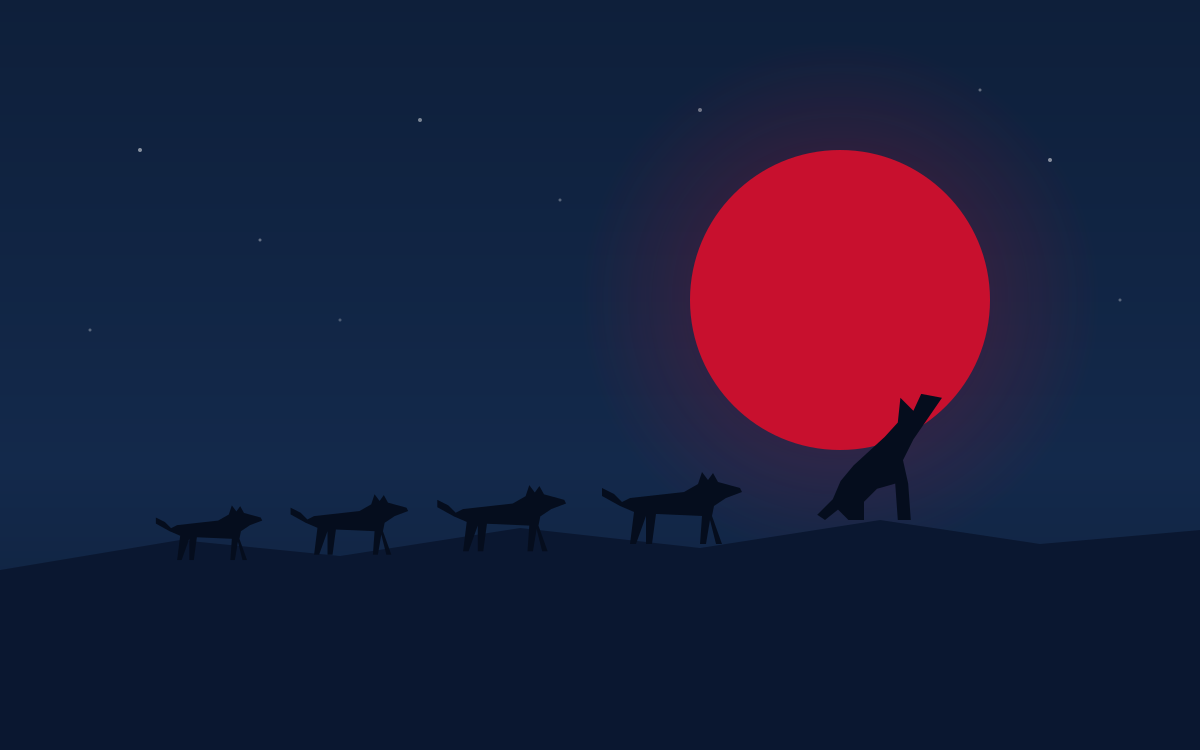
My team is not a family. My team is a wolf pack.
It may sound cold at first, yet the pack has almost everything we expect from a good team. Wolves live together and hunt together, and together they bring down prey that none of them could take alone. They defend each other, they stand up for each other, and the pack will carry an injured member for a while. There is loyalty in it, and there is care, only none of it is unconditional: it comes from depending on one another and from running for the same prey.
There is hierarchy and order in the pack, just like in a team. There are power struggles too, let's be honest, just like in an organization. And the leader stays the leader only for as long as the pack follows: it walks in front not because the title entitles it to, but because it earns the place day after day. When it no longer does, the pack raises a new leader.
And here is what matters most to me: whoever holds the pack back will not stay in it for long. Not out of cruelty, but because the pack's survival is at stake. This is also where the hardest lesson belongs: a person can be as smart, as skilled, and as driven as they come, but if they cannot hunt with the pack, there is no point in having them in the pack. A lone wolf can be an excellent hunter, but alone it only catches rabbits. It takes a pack to bring down a bison. That is why I believe being a team player is worth more than knowledge and experience on their own.
As a leader, this image also redraws my own job. It is not my job to keep everyone. It is my job to keep the pack whole: to make sure there is common prey worth running for together, that the order is fair, and that whoever pulls their weight feels the pack's protection. That includes having to let someone go from time to time. A leader who never lets anyone go is not a kinder leader; they simply shift the burden onto everyone else.
I am not saying, of course, that people are wolves. I am saying that this image speaks more honestly about teams than family does: it names the hierarchy, the performance, and the letting go, without forgetting the loyalty, the shared hunt, and the protection.
The next time you hear “we are one big family here,” pause for a moment and think it through: is it really a family? Or is it a pack that calls itself one?
What is your metaphor for teams? Tell me about it on LinkedIn.