
For years I believed I was a good leader. In truth, I had only ever led people who were like me.
I had been a lead developer for several years, and my team was made up of highly skilled engineers. Everyone knew their job, the work flowed, and we delivered. We shared a mother tongue and a culture, and at the time I gave that no thought at all. Today I know it was the biggest advantage I had. A deadline meant the same thing to all of us, we read the silence in a meeting the same way, and half a sentence was enough to tell me that someone was stuck. I never had to understand them, because they thought the way I did.
Then one day the head of development asked whether I would take on a project in Saudi Arabia. Riyad Bank needed a new internet and mobile banking platform, built by a mixed team: our engineers alongside local developers, most of them Egyptian and Syrian. I said yes, because professionally it was familiar ground.
The first months were hard, and at first I was certain I knew why. As I saw it, some of the local colleagues were not skilled enough, they did not understand the tasks, and deadlines slipped for no reason. One misunderstanding followed another, and every one of them cost time. My explanation was a comfortable one: the problem was on their side.
Today I see that this explanation said more about me than about them. Some of them did have less experience than my team back home, but that was not what held the project back. What held it back was that I had a single yardstick, my own team. Anyone who did not ask questions the way I was used to, did not flag a blocker the way I was used to, and did not say no the way I was used to, I simply failed to understand. And whatever I failed to understand, I filed under lack of ability.
Then I learned something I could have learned much earlier, had I asked. Syria had been at war for years by then. Several of my Syrian colleagues had families back home, close to the fighting, and that is where they came to work from. Next to that, the deadline of a banking project is not the first thing on a person’s mind, and looking back, I would not expect it to be. Their motivation was not the problem. The problem was that I did not know, and I had not asked.
From then on I led differently, and it was not a method, it was attention. I talked less and asked more. Where someone really stood, and why, came out one on one rather than in the status meeting. I learned that a “yes” does not always mean it will get done; sometimes it only means the person heard you and does not want to say no to their manager. And I learned to handle my own irritation: when something slipped, I looked for the cause before I looked for someone to blame. In the end we delivered the project. And I came home a different leader from the one who had left.
Leading people like yourself is easy. Leadership begins where the similarity ends.
At the time I had no words for what I had learned. Years later I read Daniel Goleman’s article in the Harvard Business Review, What Makes a Leader?, and there it was, laid out in domains: everything I had learned in Riyadh without a name for it. Goleman splits emotional intelligence into four, and looking back I can find all four in my own story.
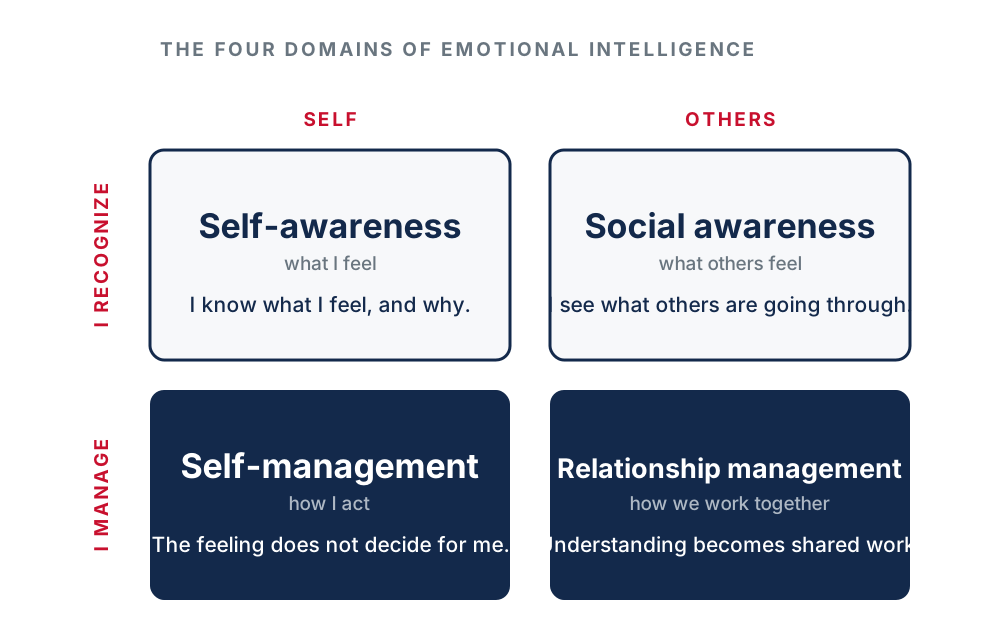
01Self-awareness means knowing what I feel and seeing how it shapes my decisions. In Riyadh, that was recognizing my own irritation before it made it into the meeting.
02Self-management means the feeling does not decide for me. The answer to a slipped deadline is the cause, not the culprit.
03Social awareness is empathy: seeing the other person’s situation from their side, not measuring it with my own yardstick. That was the story of my Syrian colleagues.
04Relationship management is where that understanding turns into work. Persuading, motivating, resolving conflict, a team behind a common goal.
When people ask me which leadership skill matters most, this is still my answer, and I know it is not the obvious one. Critical thinking, clear communication, a vision, and well-set goals are all necessary, and all of them depend on me. But a leader’s result is not what they do themselves. It is what others do because of them. I have to convince people of what I can already see, keep them motivated when things are hard, and keep myself in hand when the stakes are highest. No single skill is enough for that. But without this one, none of the others work.
I am reaching for these memories again now, because I have recently started leading a team in Central Asia. While everyone was Hungarian, the team did half of the leading for me. It took Riyadh to show me that the other half was mine to learn.
Where was your Riyadh? Tell me on LinkedIn.