Don’t be a straight-A student this year.
That is what I told my daughter in the first week of school. She is in her second year of high school, a straight-A student with distinctions in several subjects, and I know exactly how much work sits behind that.
I was not asking her to study less. I was asking her to be deliberate about where her time goes. In Hungary, grades run from one to five, and five is the best. Up to a four, learning is about understanding the material. Everything past that is about something else: the flawless oral exam, the definition recited word for word, the last few percent on a test that depend as much on the day’s form as on knowledge. The gap between a four and a five is rarely a whole chapter. It is a date, the last term of a formula, a misread sign. That stretch eats the most time and adds the least to what she actually knows.
None of this means a five is never worth it. It means it matters which subjects she pays for it in. Where she wants to study further, she should go all the way, because there, precision is the knowledge. Where she already understands what needs understanding, the time she frees up is worth more to her than that half a grade.
I am in the middle of an AI rollout right now, and the same question comes up there. The hard part is not which tool to buy. It is how far to go.
There is no grade for that, nothing you could easily score an organization against. So I started sketching what the levels might even look like:
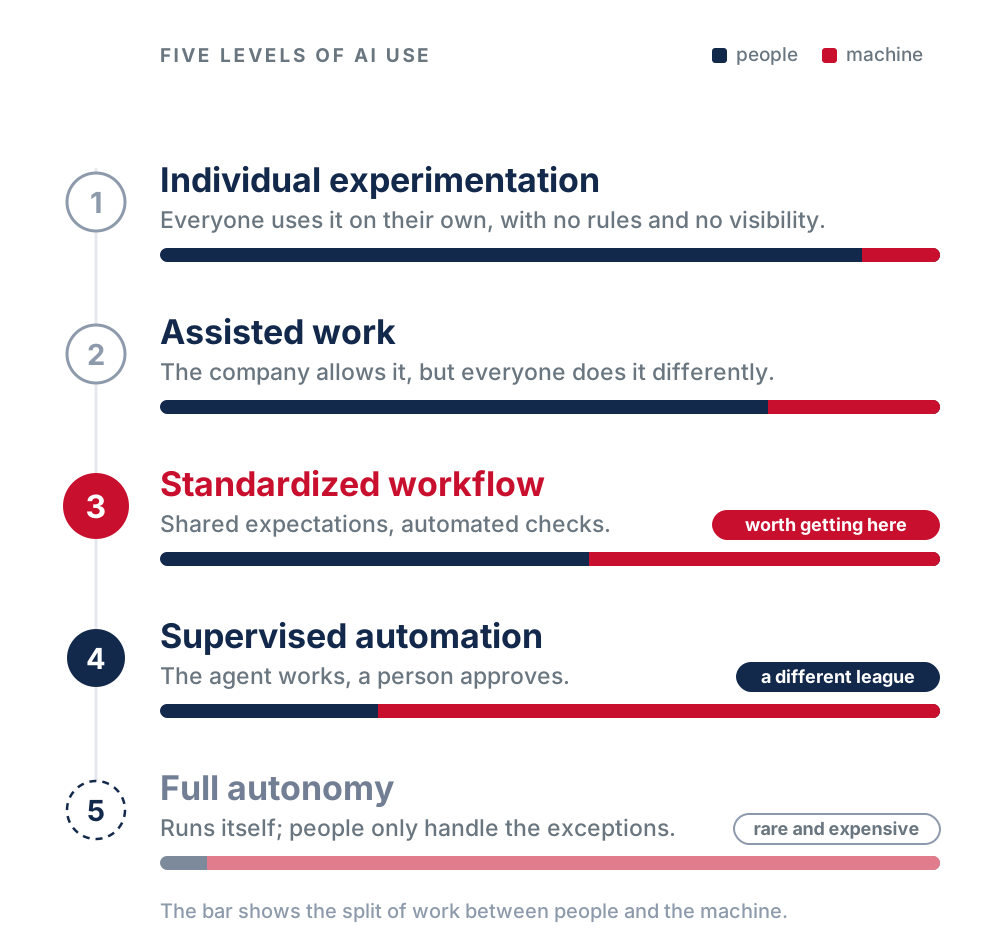
At every level I look at the same two things. How much of the work passes through the AI, and who checks the result.
01At the first level, everyone discovers AI on their own. There is no central support: whoever uses it pays for a personal subscription or works with the free tier. Nobody has said what may be pasted into a chat window and what may not. Whatever the AI returns is checked by the person who asked for it, and usually that amounts to “looks fine, off it goes.” The biggest risk at this level is not a bad result. It is that company context ends up in tools management does not know about, and that nobody sees what is really going on. Banning it is not worth the effort, because the demand comes from the ground up and it will happen anyway.
02At the second level, the company allows AI, but everyone still uses it differently. The first company subscriptions appear, often several side by side for the same task. There is a policy of some kind, but it is more a document than a practice. People start the AI by hand when they need it, and whoever starts it has to assemble the context every single time. Most leaders at this level are wrestling with the skeptics, because the team splits into enthusiasts and those who wrote the whole thing off after two bad experiences.
03At the third level, using AI becomes a shared expectation, not an individual choice. There is training, and there are teams that went first, tried things, and pass on what worked. The policy is now practice, not paperwork. The AI’s output is validated by automated checks rather than by conscience: it has to pass through the same gate as any work a person produces. The AI kicks in on its own at defined points in the workflow. This is the first level where the benefit is measurable rather than anecdotal, and where it no longer depends on the enthusiasm of one or two people.
04At the fourth level, the agent does the work and a person approves it. AI literacy is widespread, not confined to a few people. The policy follows the company’s strategy. The agent takes a bounded task, carries it through, and a person signs off before anything leaves the building. It gathers its own context. This is where control shifts from people to the machine, and it is only safe to step here once the third level stands firm. An agent produces mistakes just as fast, and in just the same volume, as good solutions. What protects you is the checking system underneath.
05At the fifth level, the system runs itself. Multiple agents, workflows spanning multiple systems, and people left only with the exceptions and the high-stakes decisions. Learning is continuous and built in, the policy moves with the system, and feedback comes from live operations rather than a quarterly report. In theory, this is the destination.
At this point I think the same thing about an AI rollout that I think about my daughter’s report card:
A half-built five is worth less than a solid three.
Looking across the five levels, I see three things. A strong three already delivers a lot, and it is where most organizations first see their money back. A four is hard to reach and few get there, but those who do play in a different league, because from then on headcount is no longer the limit. A five is not out of reach; it simply costs so much and takes so long that by the time it pays back, the tools underneath it have changed.
I did not tell my daughter to settle for less. I told her to choose which subjects are worth the price of the last grade, and to spend the rest of her time on what she actually wants to be good at.
For an organization, it is the same decision with higher stakes. The question is not which level you are on. It is where moving up is worth it, and where it is enough to strengthen what already works. Whoever chases a five in everything has not really made a choice.
Because a five does not mean you know it. It means you paid for it.
Which level are you on, and do you really need to move up? Tell me on LinkedIn.